After a life time of chasing the latest power tool, and riding the high of the ego trip that is arriving at job sites with the newest this or that thing - I've been checking non-power tools - hand tools - back to a time for carpenters, before the 'grid'.
Away from the failed automobile/freeway urban model and the resulting catastrophic global warming. Away from the inhuman out-comes: noise, super-local pollution of the air, isolation that the long distance commute to far away work produces; the longer work hours that the dying petro-economy incarnated as neo-liberal capitalism; the road rage that we are all victims of - the result of too many vehicles in the finite urban space - and on the positive side: Towards a longer life, and most importantly a better quality of life that New Urbanism's "Livable Cities" outcomes produce.
This is the new reality that New Urbanism aims to morph our cities into.
I, as one one individual in this great transformation have a unique story to tell.
I'm not an university educated architect - but what I've been doing for years before New Urbanism came to the administration of cities, was to create neighbourhood any-which-way I could --- for myself. To me that meant no car; and that meant local shops and local work - and bicycling to both. As a carpenter that meant a variety of strategies for both getting materials to job sites, and getting my tool kit there as well.
Hand powered tools are lighter, just as fast and less noisy to operate. On short-run type jobs: one offs, custom installations in people's homes - power tools are too much: too powerful, too noisy - and for this modern urban man - too stressy. There's already enough things making noise in my urban acoustic landscape; cars are by flar the biggest (and they are ubiquitous). I don't need to add to the cacophony in my personal work space, doing something I other-wise quite enjoy.
The Bosch 5312
Dual Bevel Slide Compound Mitre Saw
The absence of for example, of the startling, ear damaging noise that a circular saw motor makes - blasting the acoustic serenity of a carefully drawn line - makes my day.
Besides, they're too heavy to transport by bicycle.
So like I said, I've been checking out hand tools. Compound Sliding Mitre Saws are wonderful things, no question about it - but I have found they are for the shop, not to take into people's homes.
So, I invented this (I think) - a better, simpler Hand Mitre Box:
This drawing (I haven't built it yet) shows a one setting Mitre Box, for 90°. By adding other hard plastic 'liners' (which guide the saw's body) at other angles, you can get all the common mitres in one small wooden box: 90°, 45°, 22.3°. Horizontal angles can be achieved with this design as well. The wood for the body can be the lightest of the hardwoods - because the saw never touches the housing. I'm thinking Birch (a light weight plastic could work also - but I don't like to encourage the petro-cabal - I will not buy anything plastic that could be wood).
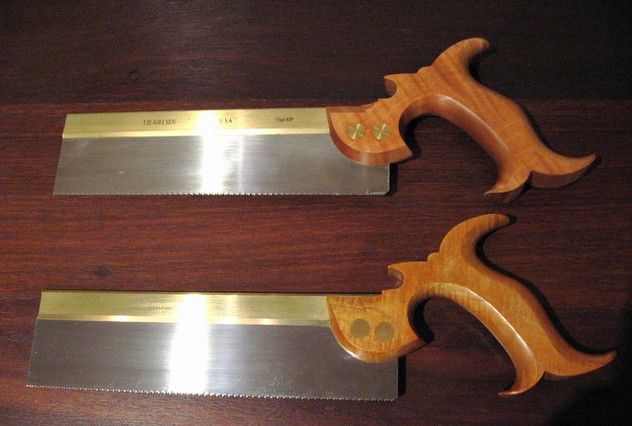
This concept allows the carpenter to use any fine tooth hand saw - no need to bring a special rigid-topped hand mitre saw (see image to the right) - because the liner keeps the blade straight - any hand saw will do.
As well the saw is easier to sharpen because it is separate from the contraption (see Image #3, below); and because you're using a regular fine cut hand saw - you don't need to bring an extra saw to the job site just for mitres. Plus the saw stores away separately, making
the mitre box easy to pack away, easier to transport by bicycle than any other Mitre Saw I've see on the market.
Because the cutting teeth never touch the guides - or the wooden box that holds them - the Mitre Box never wears; mitre's are always accurate no matter how may times the box is used (a major design flaw with the standard Hand Mitre Boxes - see image #1 below).
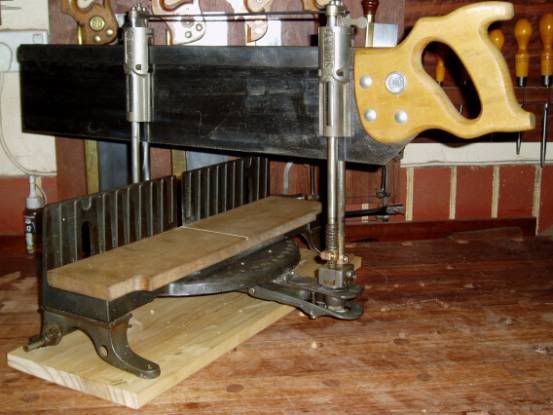
Some better Mitre Boxes have been designed to over-come this flaw () see Image's #2 and #3), but they are too complicated and inhibit the smooth motion of the saw because there are too many accute points of contact that are in motion. And all except the oldest design, have the saw built-in, which make them bulky and difficult o transport to job sites with out a automobile.
I commented also, by way of constructive criticism, that the embeds available through the new player would annoyingly, play on load; and that how content available to embed would shortly thereafter disappear behind an itunes paywall. I commented on this second quality that, the appearing and then disappearing content destroyed the buzz the content was creating in the social networks. As an example, I posted the three of the most recent 'Featured' shows.
Wiretap's oldest post in the 'Feature' section (WireTap | Aug 10, 2012 | The Big Thrill | 25:20) has now gone dead in my blog's embed. Next week the second oldest post, the David Rakoff Tribute, will go dead. The week after that, "The Lothario" (a repeat from Season 2 - 2006/05/14) will follow the others to the itunes, open internet graveyard.
Interestingly - even though it is not a part of the Apple Inc. itunes paywall contract - the Season 2 post from 2006 will go likely go dead along with the others, because the webmasters at CBC have placed it in a new player, rather than the Season 2 player - which I embed here as an experiment:
WIRETAP | May 14, 2006 | The Lothario | 27:30
I fear that CBC executives will take from these observations that embeds interfere with the paywall - so disable embeds.
But what I have tried to show here, and in all these posts on WireTap over the years (as part of my learning), is that the social networks are a key part of the metric of social network marketing. Paywall if you like - but don't put up open internet episodes for a time and sequester them later behind a paywall. Pretending to an open internet meme and then pulling down content destroys the connections established in the social networks; and pisses of internet users going forward as they run into, not paywalls, but dead ends!
From observing CBC's online strategy from the user's point of view - when a company releases a security to the open internet it must stay up until it has run out of energy pushing eyes to the 'pay-for-view', most recent episode (perhaps, the life time of the production).
Therefore, sequester the most recent episode behind a paywall for a time - and then release it to the open internet, with all the fanfare and celebration that a release to the commons deserves. The smart phone market, people who have already purchased the episode in the 'immediate market', can then brag with-in the fanfare that they have already heard the episode - and then talk about it, adding to the buzz.
NPR's "This American Life" has the idea properly sussed. At their site all the episodes are up for free: to download, to stream at the site in a player, or via various smart phone apps.
To monetize, "This American Life" have a separate tab called 'Store' where content is sold as DVD's, in 'Collections' and 'Behind The Scenes' productions. Also T-Shirts, Books, Mugs and Posters from the shows periodic Live Events are offered - along with unique toys like a "Custom USB Drive With Rare, Unreleased Interviews (Plus TAL "Behind the Scenes" Video)".