Alert! Three CBC embeds will begin to play on load - to turn them off scroll down.
This Week on A Translation of WireTap with host Jonathan Goldstein - I review the new "CBC Player".
The new video / audio player allows people to embed CBC content on their websites. These embeds can act as a portal through which users can transport to the CBC Player. In this case to the Wiretap Episode Archive: www.cbc.ca/player/Radio/WireTap/.
The new CBC Player - in it's radio incarnation - has two key issues:
1) Autoplay
The embeds begin playing with out prompt; which I will not have on my web site - except in this instance as it is a review of new technology. The reason I don't allow auto play content here is because if someone loads my blogs landing page, and this post is buried down on the front page - all three player will begin making noise and the user won't be able to easily find the off buttons - so they will 'bounce'.
I always ask the user whether of not they want content I offer.
WireTap | Aug 24, 2012 | The Lothario | 26:27
(repeat, season 2, 2006-05-14)
WireTap | Aug 18, 2012 | David Rakoff Tribute | 26:29
(new, 2012-08-18)
WireTap | Aug 10, 2012 | The Big Thrill | 25:20
(repeat,season 7, 2011-05-20)
2) Appearing / Disappearing Content
Above, the August 18, 2012 content embed will disappear in a few weeks - as it is CBC's policy with regard to this particular production (a Wiretap / CBC co-production) - that only the two most recent episodes are made available at the CBC portal. I assume that - in order to drive paying customers to the itunes download - some time soon this show will be taken down; thus rendering the CBC Player embed here dead. That's bad for readers who got here via search, because of the CBC Player content embed. An unsatisfactory dead-end to their search of CBC content is likely to leave them with a bad taste in their mouth, and thus less likely to continue from here to the CBC Player.
I think the solution to this conundrum is to recognize that the itune's pay market - as opposed to the market defined by other devices - other user 'place' experiences - constitute two different markets. The up-to-the-minute, always-on wherever-you-are, smart phone market has a immediate temporal quality that defines it's value.The archive of past shows has a different value, and should be priced (or not) accordingly - at the same time it is important to remember that the two memes drive each other.
Therefore, the architecture of this two-stream-content-matrix is to offer the newest episode to itune's customers for some number of days - creating a buzz there - and then present it at the CBC Player page, creating a secondary buzz which will amplify the first wave. And leave them up --- so, as new episodes become available at the Player - and in turn connections in the social networks are established - they stay established; and thus maintain their value in driving eyes to the CBC pages. Once users get to the CBC archives they are very likely to pay to listen to the latest episode on itunes.
I wonder if itunes recommends a multi-media architecture for content producers? I wonder if they insist on this kind of architecture?
That is all.
(translations may vary according to sub-cultural bias)
mh
Saturday, August 25, 2012
Wednesday, August 8, 2012
Digital Rights Management could save Public Libraries, the Open Internet - and vise versa
Originally published on my Wall, at Facebook
This really cool:
I'm reading "Days of Destruction, Days of Revolt" by Chris Hedges and Joe Sacco on my desktop!
I went to Toronto Public Library (TPL) online, searched the title; found the ebook entry and clicked on the preview button (a blurb beside the ebook entry says all 4 copies are out already.
(??? '4 Copies' 'Out' ? - that doesn't make any sense - one copy is an infinite number of copies - it's an ebook!!!)
So, like I said, I clicked on the preview instead - and nothing happens - my OS says it will search the internet for the right program to open the file, so I say OK. It came back with nothing. So I copy and searched "Adobe EPUB eBook" (which sits rather innocuously under everything in the Library listing) and that gets me to Adobe's site - where I searched the term internally, and that gets me to the download for the Adobe ebook reader, "Adobe Digital Editions" - http://www.adobe.com/products/digitaleditions/
(Adobe is a victim of their marketing department - which turns English into brand names - which inside the sub-culture of the company become actual English - and then they try to use those words to communicate with us out here - and it doesn't work. I don't understand the words "Adobe Digital Editions", it sounds like a place where I would find ebooks - but I wasn't looking for an ebook, I was looking for an ebook reader - so search didn't work, trial and error got me to the page - it took me some time to get there; turns out "Digital Editions" is the brand name of Adobe's DRM enabled, ebook reader.)
The preview TPL is offering outside of the 'copies' it's being allowed to dole out 4 at a time, is Chapter 1 of the book, the story of Pine Ridge, South Dakota.
I've changed my mind about Digital Rights Management. Hither-to I've been a devote of Cory Doctorow's take on the digital revolution with regards to book publishing. He makes all of his book available online in full from the moment they are published in paper. His take is that he'll make his wages through 'reputation', he makes enough money to keep writing full time by doing speaking engagements, readings of his books etc. - more than he'll earn from the actual sale of the books themselves.
I'm of the opinion now that DRM is great - because it allows Public Libraries to get inexpensive, digital copies of books immediately upon publication - to loan out.
The entire book downloads onto your hard drive - but it's in a kind of Temporary File that erases after a certain amount of time. Users can request a renewal of the ebook - and that is allowed depending on the settings the publisher sets in the loan agreement.
Now - if I was a hacker - intent on defeating DRM there IS a way - as soon as the text of the book makes it's way to my computer screen it IS copy-able - Somehow; I don't know how, but I am as sure as I am that the sun will rise - there is an interface that can be constructed to copy what appears on one's computer screen.
 |
| Print Screen of "Days of Destruction, Days of Revolt" by Chris Hedges and Joe Sacco - page 13 (Chaper 1) in ebook reader "Adobe Digital Editions" |
So then I am victorious-cyberpunk-hacker-champion !!! But what''s the point? The book's available at the Library for free. :)
This is the best argument for DRM I have ever heard.
And I came up with it !
But then the gobbledygook coming out of the special interest media towers isn't much competition - blinded as they are by greed, and the popular media of greed - money.
* * *
Originally published on my Wall, at Facebook (edited for clarity) (https://www.facebook.com/michael.holloway.90281/posts/441346309243176)
(I want a widget that can take posts I create in FB and posts them here if I click that button on my browser - I say browser because I know FB would never allow the app - at Faceboook it's Everything in - Nothing out.)
mh


Monday, August 6, 2012
High-frequency trading 2007–2012: an animated .GIF
High Frequency Trading machines are computer programs that can trade stocks at rates measured in fractions of a nano-second.
.GIF representation of HFT trading 2007 - 2012, created by Nanex (http://www.nanex.net/index.htm)
Nanex ~ The Rise of the HFT Machines
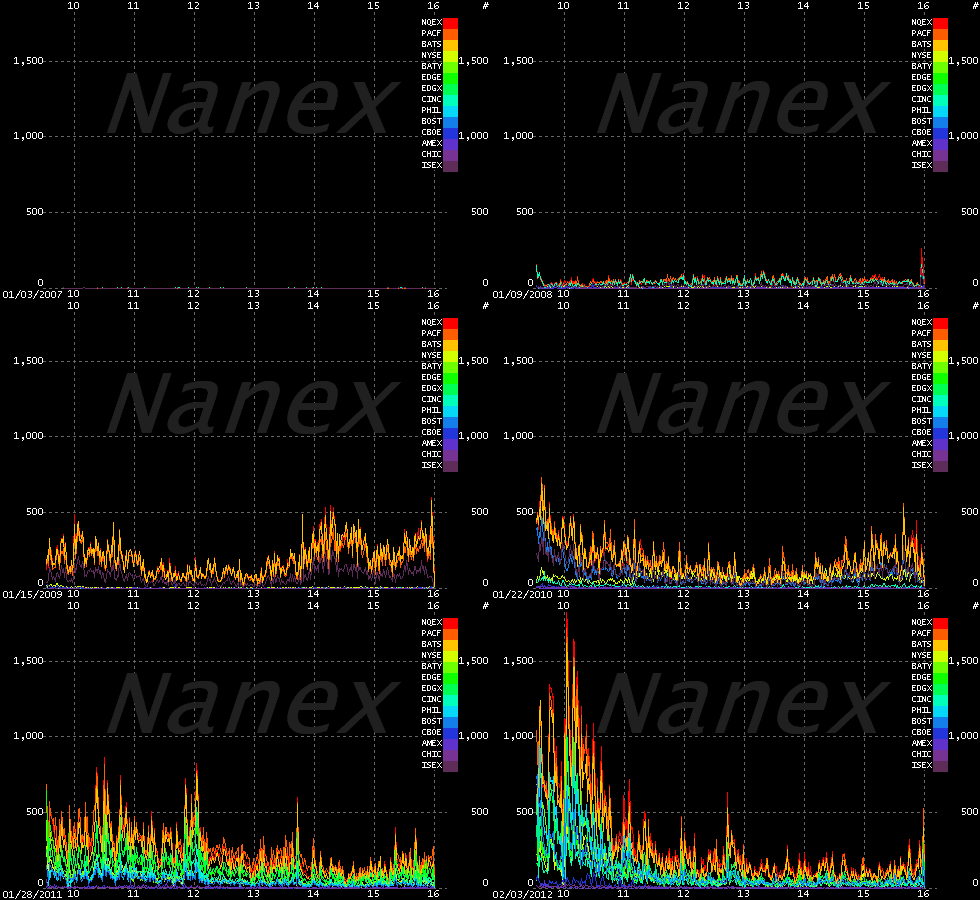
On May 6, 2010 - beginning at 14:42:46 and ending at 14:47:02 - the Dow Jones Industrial Average (DJIA) dropped approximately 600 points (5.7%), and then quickly recovered. The so called "Flash Crash" was traced back to high-frequency trading programs that over ran Exchange computer's ability to handle the volumes.
See Nanex's report on that incident here: http://www.nanex.net/20100506/FlashCrashAnalysis_CompleteText.html
Gif discovered via a Tweet (embed):
The rise of high-frequency trading, 2007–2012, in animated GIF format: nanex.net/aqck/2804.HTML
— Paul Ford (@ftrain) August 6, 2012
See also, Zero Hedge, 2012 Feb 06 | Presenting The "Rise Of The HFT Machine" - Visual Confirmation How SkyNet Broke The Stock Market On US Downgrade Day | http://www.zerohedge.com/news/presenting-rise-hft-machine-visual-confirmation-how-skynet-broke-stock-market-us-downgrade-day
.GIF hosted at http://www.nanex.net/aqck/2804.HTML
mh
Subscribe to:
Posts (Atom)