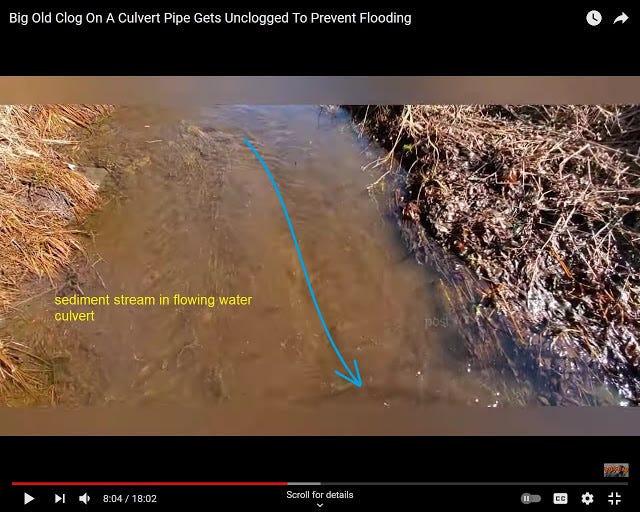
I was considering the way water at speed, can carry sand, but when it slows, it can no longer hold it's buddy sand and water has to slowly let sand fall; he's gotten too heavy to support.
gravity is indirectly proportional to speed
like the escape velocity of a rocket, the faster you go the less effect gravity has on you
i feel like there are examples of complex physics all around us ... and finding ways to see, is a way forward toward a better understanding of how the universe works
one of the ways i am 'seeing' is through investigating the boundary layers between matter in any form; water(vapour layer) is one of those
In the classic Double-slit Experiment light seems to behave both as a particle and as a wave.
A beam of light aimed at a barrier with two slits in it creates a pattern of light and dark bars on the screen behind it. In the GIF below one can see how the light passing through the two slits creates a wave interference pattern which results in the light and dark bar pattern on the screen (on the right).
GIF showing a mathematical function of two waves colliding, creating an interference pattern signature on the right hand side of the image.
If light was a particle (called photons) we would see just two bars, a conglomeration of specks on the recording surface - instead we see a long line of bars.
So - in the interference pattern created when one electron is fired at a series of slots is actually a field fired at the slots, and thus the electron's field passes through both slots.
So light must be a wave - right?
More proof of this is added when the same experiment is conducted using individual particles (electrons for example) - where only one particle is fired at a time, one at a time, over and over and over, at the barrier with two slits - amazingly the same interference pattern of light and dark bars eventually is created on the detector screen!
After watching one of those science specials where some Physicist tries to explain Quantum Physics, here's how I, just now, imagined a solution to the problem:
All particles have a degree of energy; thus a corresponding field. Thus one could say that particles are actually not particles - they are fields.
As the particle (and it's surrounding field) travels through the background frequency of the universe (or through the frequency of the light in the room where the experiment is occurring), the interaction of the two fields creates a resonance pattern which is a function of the interaction of the two fields; which creates a sympathetic resonance wave - which determines where the particle arrives on the observation plain (the detector screen).
Speed is a form of matter - in that it has energy. So, separate from (but integral to) the field created by the frequency of the electron, is the field created by the speed at which the electron is traveling. [Speed is a dynamic quality - as any mass in motion loses speed over time (entropy) - thus the electron slows down over time; and thus - the field created by the particle changes; and thus - it's interaction with other fields it is passing through also has a dynamic quality. Thus the entire universe is a dynamic algorithm - an unknowable function (because we don't have enough information - the problem is too complex; we don't have the interments to measure the medium that will reveal the function).] 1
More interestingly, the field of the electron (based on it's vibration), is accompanied by another field associated with the speed of the electron created in the act of firing it. This 'temporal distance traveled field', plus the electron's 'vibration rate field', creates an complex field which, creates a functioning of two fields that creates a field of it's own (with-in the boundaries of the functioning fields) and determines the actual position of the electron with-in the functioning of the two fields. Then add the field associated with the medium through which the electron is fired - and you have an seemingly unpredictable path to the observation surface.
Thus the seemingly random position of the electron, and the probability calculations that is the basis of Quantum Probability.
Based on the decaying speed of the electron over time (which in itself is a temporally changing interference pattern)...and then the interaction of the frequency of that electron and the medium through which it is traveling - creates a interference pattern - which changes the direction of the electron. We thus have the seemingly improbable functioning of the nano-universe.
The model is correct over time - but not at one time; thus the probability equations that work in applied science.
Entropy
I've been thinking about the nature of entropy for about a year now, and I have created a thought experiment that concludes the continuing expansion of the universe is the 'finishing out' of the initial big bang. What we see on earth - and in the solar system - is an increasing complexity (not a simplification, a resolution down to the simplest form); so therefore, our micro-view of the explosion may be the function of the dissipation of the original explosive force (the snowflake algorithm - the fractal pattern of the explosion (our 'Rumsfeldian slice'2 view of a temporal function - that has a life-span of 14 billion+ years).
2"Rumsfeldian slice" describes perception within a rapidly changing complex function. See Rumsfeldian slice defined by current use in Twitter Channel "@kgcentral" description | https://twitter.com/kgcentral
The places between the high and the low pressure areas - as we understand by every day living through them - are areas of chaotic and unpredictable 3-dimentional functionings.
As a metaphor for E=mc2 we can begin to appreciate the 3-dimensional functioning of the universe; the places between the gravity well that is a planet orbiting through space - through the matrix that is mass functioning in time-space - is very likely a chaotic place full of turbulence. In astronomy this chaos region is invisible. At this point in our understanding we cannot record it, measure it.
Is this chaos in the 'fronts' between matter and time-space the missing dark matter?
I been thinking about an experiment that MIT did a few years back (1908) - in an attempt to once and for all prove or dis-prove the "Coriolis Force" - the issue of whether or not water tends to rotate down through a drain out of a basin in the opposite direction in the Southern Hemisphere, as opposed to the Northern Hemisphere.
I always thought this was a done deal. I thought it was a scientific fact that water rotates counter-clock-wise in the Northern Hemisphere - and clock-wise in the Southern. Apparently it is not all that simple1.
I just did an experiment with my kitchen sink. I filled it up and then tore off little threads off the edge of a rag and dropped them into the filled sink. I was surprised to find the they immediately took off around in a counter-clock-wise direction. I surmise that the energy of the water being forced out of the feed line + the drop of 20-30 cm over the fill time - had imparted some energy to the mass of water. By happen-stance probably, the water arrived at a rotation based on a roll of the dice - the dice being the chance way in which the water filled the sink (did I change the position of the spout? I can't remember).
I'd have to repeat the experiment a number of times, positioning the spout at several different stations of it's arch to see what if any difference that made in the rotation.
So at any rate - I waited about 10 minutes for the mass of water to stop showing signs of a rotation (there was still movement but it appeared random (likely turbulence caused by heat exchange between the water and the sink; the water and the air).
I dipped my hand slowly in, and gently pulled out the drain plug.
The water went straight down!
No vortex ever developed at the centre of the drain hole - where one would expect that to happen.
Apparently a vortex only forms (in such a small tank) from the general rotation of the mass of the water after doing dishes of whatever, before one pulls the plug!
So now to my thought experiment - the reason for this post:
What would be the result of an experiment where one did the opposite of this 'still tank' experiment?
In the Northern Hemisphere, midway between the equator and the pole - set a mass of water n rotation in a precise way (using for example, a paddle rotated by a motor), and remove the paddle motor assembly in a repeatable mechanical manner. Then open the drain plug in a similarly repeatable mechanical way. Now measure the rate at which the mass rotates until all the water has drained.
Repeat at different rotations direction, different rotation rates, change height of column of water.
Then repeat the whole thing in the Tropic of Capricorn.
I predict that the dynamics of the two fields (that of the mass of water rotating, and the magnetic field of the planet - or is it the dydnamic field created by the mass of the planet rotating, orbiting?) will magnify the Coriolis Force.
The speeding or slowing of the mass of previously rotating liquid (a mass with a dynamic field) will reveal a force, the result of the interaction of the two fields. The properties of the resultiing field dynamics should be a function of the math of Gaspard-Gustave Coriolis2.
Perhaps there will be a gradual slowing of the rotation as the vortex forms. Nothing would surprise me, after my little sink experiment just now.
[1] Wikipedia | Coriolis effect | Draining in bathtubs and toilets | http://en.wikipedia.org/wiki/Coriolis_effect#Draining_in_bathtubs_and_toilets
Also - physics.ohio-state.edu | Dave Van Domelen | The Coriolis Effect | http://stratus.ssec.wisc.edu/courses/gg101/coriolis/coriolis.html (reprint by ssec.wisc.edu)
[2] University of Wyoming, Atmospheric Science, Dept. | E. Linacre and B. Geerts | Gustave Coriolis, and the Coriolis effect | http://www-das.uwyo.edu/~geerts/cwx/notes/chap11/gustave.html (links, vernacular)
Also - link.springer.com | Prof. Dr. R. E. Roberson | A form of the translational dynamical equations for relative motion in systems of many non-rigid bodies | http://link.springer.com/article/10.1007%2FBF01387376#page-1
Been thinking a lot about fields in the last year. Fields are key to understanding how water moves - and water is the thing that is at the core of my attempt to understand the relationships between macro and quantum properties of the universe - towards a grand unified theory.
Fields are very hard things for our brains to understand. I think it's because we evolved in a gravity well. Gravity wells distort fields, flatten them. We see the world lineally - a function of this flattening. When we begin to observe outside this gravity well in the relatively entropic places, we can't understand what we're seeing. This is what is causing the stall in our trip towards a grand unified theory of everything (that will get us hover cars).
:)
Fields want to be spheres, but other fields (like the mass of the earth) distorts them and creat sympathetc, tonal fields with virtual poles. So the idea is to study what we know - and what we know best is water. We are 99% water, this biosphere we live in, evolved in, is a series of layers of water in different densities. The living earth that sustains us is dead earth, sand ground down from rocks, without water. All life on this planet (which can be understood to be the furthest point from entropy that there is) depends on water.
Thus the fields that these various densities of water have - and how they interact - is is the best way to understand how fields are related as the fundamental structure of the universe.
Watching TVO's "Shock and Awe: The Story of Electricity: The Age of Invention" the show talks about one of the fundamental discoveries that has lead us into the industrial age - Faraday's law of induction - but more important for me in my fields thought-arch, was the beginning of an understanding of quantum fields.
How fields interact is what fascinated the self-taught Faraday - and although I don't have the tutelage of a scientist as he did I have Wikipedia and 200 more years of learning that he didn't.
So Faraday experiments where he first began to reveal the properties of interacting fields in this series segment was particularly interesting to me. The key idea he discovers is the Induction. Induction results in current and in essence, is caused by the intersection of two fields and motion! This creates an electrical charge - the foundation of the modern world.
Induction is somehow the result of interference pattern created though the intersection of fields - and the other element - again we don't really understand this motion of a third field through those interference patterns and how exactly that creates a current.
The temporal quality is especially interesting to me. I will dwell upon it - while the vast majority of thinkers in the past period have left it aside - the laws that Faraday revealed are good - they work in the real world - lets forget the somehow magical properties of the thing and move on - build this here that we have built.
All very well - until Dark Matter raised it ugly head.
That's it for now. This blog will 'Tumbler'.(update at this address).
This outline of the direction of my thinking is the clearest I've laid it out to dat e- lots of thoughts coming out of this. For example, the induction created (the poles created, the current created) when two fields pass each other can be seen as: the core magnet, Earth, and the field in motion, the weather systems - the current is of coarse - lightning.
Thus: Can one simply lay one side of a 'Faraday Cage' on the surface of the Earth (the one field) and then take electricity off the cage as the weather (the mobile field) passes over it? How big to light a city? Is our existing electrical grid (one side of a Faraday Cage) producing electricity right now? How much? How can we maximize this induction?
A different way of looking at things than what we taught in Grade 11 Science - where differential charges are the explanation. It is not accurate.
Acoustic Levitation....
At the US Department of Energy's Argonne National Laboratory scientists have been experimenting with sound waves and pharmaceutical solutions, levitating soluble drops b/w two speakers facing each other. While there research have produced some visually fascinating results. It has also led to the discovery of a far more effective method for creating amorphous drugs, which happen to be more desirable of two forms that pharmaceutical drugs can take.....
(Lots of skepticism in comments under the Tim O'Reilly post for some reason.)
Here's the my comment under Tim's piece - that I didn't post:
Fields are interesting. The intersection of fields is even more interesting.
Recently I've been watching an NTSB air-crash-report based documentary series by National Geographic.
One plane crash investigation that was particularly interesting with reference to wave interactions showed how wingtip vortices can cause control issues for pilots flying behind other aircraft. As a result of the discovery of this kind of turbulence, the NTSB asked NASA to look into the phenomena.
Particle physics described by quantum calculations seem to live in a separate universe from that which we observe in larger scale transferees of energy - which we observe as waves. The visualization of this, the classic pebble dropped into a pool of water: pebble hits the surface of the water and creates a series of concentric waves which emanate out from the point of first contact. This is a two dimensional representation of a 'field wave bubble' (my term, I think).
The way I try to visualize this is the concentric waves of photons (better is concentric bubbles, or spheres) expanding away from the surface of the sun. Understanding how a bubble can be a part of a wave, and how distinct bubbles are connected to the bubbles just in front - or behind - is a difficult visualization. We tend to see the world in a two dimensional way - three dimensions is often a mental interpretation of what our eyes are perceiving; a map of understanding that our brains construct to exist in the three dimensional space. Add the forth dimension, time, and our ability to perceive what is really going on results in many more cognition errors.
Understanding how fields interact might provide a clue to how particles create field waves. For example: is Light a wave? Or a stream of particles? Is an oscillating stream of particles a wave? How can we visualize a wave as both a stream, and a wave? What qualities of a series of wave particles reflect the essence of what we see as a wave?
Understanding how dynamic fields interact is perhaps a route to understanding the connection between particle physics and wave physics.
I've been interested in dynamic field waves for a number of years, as a way forward in understanding the difference between the characteristics of particles, and the characteristics of waves. For example, is light a particle or a wave? This is a conundrum that we have not worked through in 300 years of trying.
Most physicists agree it is both. This is best illuminated by the double slit experiment. Throw random particles at a barrier wall with two slits in it, and record where the particles hit on the other side of the barrier wall - and you will get an interference pattern that reminds of the field lines of a magnet - a reflection of the interference created by the barriers between the slits (with something else added?).
Turn on the lights and repeat the bombardment, and the interference pattern doesn't present.
Here's an animation from Wikimedia (and see a talk on this in the link list below):
The field that we exist in might be the best field to observe in order to understand fields better.
Our atmosphere is for the most part, water vapour. At different elevations from the surface of the earth that atmosphere holds varying percentages of water - more near to the surface less and less the higher off the ground you go. These differing characteristics of the air at different elevations creates distinct air masses, which behave differently depending I think on their mass - a function of how much water they are able to sustain. So we can look at the interfaces between those layers to discover the characteristics of field wave interactions.
Another field intersection that we are very familiar with is the vastly different characteristics of the field that is liquid water (the oceans) and the field that is the atmosphere that contacts them at the seas' surface.
Also been thinking about how trees get water all the up to the top from the roots.
(or do they?. New understandings from forest management indicate that much of the water at the top of especially the tallest trees, California Red Woods - may come in part, from rain, which the trees' leaves are specifically designed to collect and store.) (National Geographic - Redwoods http://ngm.nationalgeographic.com/redwoods/redwoods)
Our standard explanation of this seems inadequate to me. The idea is that "capillary action" is responsible for this seems doubtful as that means that the process is essentially electromagnetic in nature. The magnetic forces involved are tiny when compared to the force of gravity pulling in the opposite direction. Are there other forces at work? Is the electromagnetic attraction an indicator of another proximate field that the municus is a refection of?
The meniscus that we see at the top of a beaker of water indicates that an electromagnetic attraction between the glass and the water molecules results in the concave incline all around the inside of the beaker - that rises above the surface of the water. In trees, the idea goes, the cells transfer water from one cell in the trees cellular structure up to the next cell through an electromagnetic process. - but as the cells themselves, are almost completely water - it must be the cell membrane that facilitate this attractive force between the the membrane matrix of molecules and the body of water molecules... . Or do we need to also look at the combinations of different matrices: the membrane matrix creates a field, the water within them create fields and those collection of fields also create a sympathetic field - and that in turn, interacts with the membrane matrix field. :\
2013-03-17 -Some thoughts on 'Containment Fields' (original post)
A 'containment field' - as in Star Trek the Next Generation episode, 'Realm of Fear' - could be a three dimensional figure eight, the top, middle and bottom of the shape, three nodes and the wave sign of a particular intensity of energy ... where the field, when viewed in two dimensions - is shaped like a figure eight - but each field line of the field traces a line from one pole to another (180 degrees), and at the same time, spirals 360 degrees down to the middle node of our figure '8'. And then the field line spirals around and down to the bottom most node in our thought-model:
Then multiply by millions electromagnetic strands - artificially produced in science fiction by some sort of highly complex set of field generators perhaps, working in conjunction - like a holographic projector. This three dimensional figure eight field is but one of an infinite number of shapes energy morphs into at different frequencies. And these three nodes - in our thought experiment - are but one wave sign of - perhaps one could imagine - an infinity long winding thread of energy spiraling through the solar system; connected less and less with it's cousin wave patterns - some born a nano-seconds before - and nano-seconds after - are now distant particles in the coldness of the outer solar system.
One could use this thought-model to then envision the spherical waves of energy off the surface of a sun. An expanding, evolving series of matrices; field lines morphing from state to state, changing over time; energy intensity; and the distance of their journey away from the star.
From measurement in the nano-second scale of changes happening near the moment of it's birth - to the eaons of time that may pass as energy from the star sends (for example) light energy to the furthest reaches of the universe.
Why are there are no curves inside of gravity wells? (which are, in essence, curves) And nothing but curves outside of them? (curved space)
All celestial bodies from our moon to the Milky Way Galaxy and greater constructs are like our planet Earth - a system made up of a series of perfect spheres - the result of gravity pulling matter closer and closer to the centre of the mass. The different characteristics of that matter creates concentric layers we see from out micro-level, as the stratosphere, the atmosphere, the biosphere, the ocean, the crust, the mantle the core.
Inside a planet's gravitational system it seems we cannot define the essence of a curve.
Pi is our formula that approximates the essence of a curve. Pi describes a series of straight lines (the opposite side to the acute angle of an triangle) that - at a certain size - when placed like slices of a pie around a centre point appears to form a curved line. Humans have so far understood that there is no way to measure the radius of a circle.
Pi measures the flat distance at the end of an infinity (theoretically) small slice of the the circle - which approximates a measurement of the circumference of the whole circle.
Our in-ability to perceive the nature of a circle is likely a function of a relative distortion of that particular construct inside a gravity well - for undoubtedly there ARE curves here - but for some reason we can't measure them - we don't yet understand them. Our mathematical language - which explains, describes, many, many things here - is unable to encompass this very simple, very prevalent thing.
Thus one could say, that in the relative universe of this species - which has evolved over 4 billion years entirely inside a gravity well - there is so far, no way to understand a circle precisely.
On the other hand, outside a gravity well - there are no straight lines!
In outer space - outside the various gravity well - we know from Albert Einstein's general relativity, that there are no straight lines - all things traveling through space are effected by the gravity of the system - thus curved space.
Outside of gravity wells there are no straight lines - only curves. Inside gravity wells there are no curves - only straight lines.
This is a way to sum up one of the great modern conundrums of cosmology:
The total mass of galaxy - that we can see - is too low to keep the galaxy from flying apart at the rate it is rotating.
So cosmologists have imagined 'Dark Matter' to make up the missing 'collapsing' force - to counteract the centrifugal or 'expansive' force.
I have always said, "Hooey!".
I have been thinking along the line that orbits is where the missing matter - or energy lies. So I imagine (as I'm watching the video below) the path of an orbiting electron around the nucleus of an atom; the moon around the planet; the planets around a star; the stars around the centre of the galaxy...
..and then tried to imagine the path of all these things over time - a steadily thickening path of layers upon layers of paths - and the regions around them that slowly become 'familiar with their regular neighbours.
So one can imagine a field around the bow-wave of the orbiting thing - but not just around it but in it's wake as well ... ..and as it trod the path for the life-time of the sun - a field 10 billion years in the making.
Those masses of orbiting things create fields --- not just where they are at specific moments - but as in something quantum mechanics illuminates, they exist *over time* in all places along their orbits - all the time.
This Temporal Field is a function of mass and gravity over time - a force that combines with gravity to balance off the expansive forces.
The missing matter is the intricate interweaving of billions upon billions of temporal field matrices.
Inspired by these pretty pictures:
Journey Through the Milky Way (2011) National Geographic
"So then I imagined speeding up the orbits of all the solar systems' planets to that of orbit rates of elections around the nucleus of an atom. At that mathematical extrapolation is there a slow wave particle - an X-ray for example - that compares to the speed of a spacecraft? Then, if one compares the calculated pioneer anomaly diffraction to the diffraction of an X-ray hitting a particular atoms' orbital field - would they be similar?"
I'm not an astrophysicist, or a mathematician. I'm an amateur cosmologist - I understand the standard model of the universe, Newtonian physics, Electromagnetic theory and Quantum theory; and I think I have a pretty good understanding of General Relativity. I keep up to date with the most recent theories and on the latest experiments being designed to test them - and I eagerly await the mathematicians and computer modeling experts pronouncements on what the new data means to the various theoretical models.
The mysterious dark matter that is necessary to complete a grand unified model of everything has been theorized to be subspace energy - an anti-universe, a harmonic resonance of the universe we experience. Other theories have attempted a way around the numbers that don't add up, by imagining 11 universes - the so called String Theory of everything.
I've always thought these were too complicated. Ockham's razor postulates that all things being equal, the simplest answer is probably the right one. Well, all of these theories are equal, in my opinion. They all attempt to unite our understanding of the subatomic universe, the electromagnetic universe and the the so called 'weak forces' governed by Newtons Laws of Gravity and the Laws of Thermodynamics with very complex conjectures, and bring into the calculation some unseen matter, force, or reality.
So I started down this path with the question, 'What if we kept it simple?'
One thing that I've discovered in researching for this article is that there is very little known about the combined energy of the functioning of a solar system.
I asked myself, what is the total inertia (mass + vector) of all the planets and the sun of our solar system? It's not as easy a calculation as one might think. At first I thought - well you just calculate the mass of all the planets and their moons, and the sun, then add in the various speeds at which they travel around the sun - and the moons around their planets, and the orbit of the sun - and presto - the inertia of the solar system.
But then I started to consider the combined spins and orbits of all these masses:
One must measure the shearing forces in play in this increasingly complex calculation - what fields do these forces create.
What about the spin of each body and the different spin of the different layers in those planetary bodies? Some are gaseous bodies that have no 'solid' surface as we know solid here on earth - thus more complex spin and field characteristics.
What measurements do we have of the complex machinations of the different density belts of those planets - the rings of Saturn for example? Each planet would all have different spins, and thus different field characteristics based on the relative densities.
For example Earth's atmosphere has spheres of different densities - they all spin at different rates, and those different rates of spin also have interface zones that have yet more spin characteristics including eddies and counter eddies that create fields, and inter-field machinations that effect the whole.
That's not even mentioning the magma under the crust of this planet that moves according to the spin of the whole and it's density.
And now add in the atomic forces, and how they behave under different pressures which change the closer you measure to the centre of the planet - and effect greatly their spin characteristics.
And what about the forces that come into play when all these bodies enter into the acute 'ends' of their elliptical orbits twice a year?
And do the interactions of this huge number of fields create harmonic fields?
A supercomputer would be needed to calculate all these vectors - but so, OK, now (theoretically) we have a number.
But what does it mean?
This question sent me to the Laws of Thermodynamics; 'Entropy' (laws 1 and 2) say that all systems will eventually lose all their entropy and move towards a stable state, as they do so they give off heat. So the solar system is - by the scale of the age of the universe - at a very low state of entropy. All through the life of this solar system - from gas clouds to the formation of solids and so on - the system as been giving off heat - as all thermodynamic systems do while they simplify down to their most stable state. Thus the temperature of the universe is a function of the continuing entropy of the universe. The entire mass of the universe was calculated, and a temperature that empty space should be at was determined - and tested - and found to be true.
But that very broad, macro-calculation is where we're at as far as this kind of calculation is concerned.
Can we do better?
NASA - artists' conception of the
Bow Wave of the Solar System
The Pioneer Anomaly brought to my attention the idea that - theoretically - the solar system has a Bow Wave. As the spiral arm of the Milky Way Galaxy thrusts this solar system through the matter of the universe (approximately 1 atom per cubic metre), the orbits of all the planets create a field that can move small, slow objects off their vector - diffract them. Just like an atom has a field around it created by orbiting electrons - that we can calculate by measuring the diffraction of x-rays bounced off of it - so too perhaps will a larger system of orbiting bodies like our solar system, have a field which can be measured.
So then I imagined speeding up the orbits of all the solar systems' planets to that of orbit rates of elections around the nucleus of an atom. At that mathematical extrapolation is there a slow wave particle - an X-ray for example - that compares to the speed of a spacecraft? If this is so, if one compares the calculated pioneer anomaly diffraction to the diffraction of an X-ray hitting a particular atoms' orbital field - are they simailar?
If so that force calculation determines a particle wave that forms from orbiting, spinning bodies of any size - then that calculates the properties of a Higgs-boson particle.
I was reading my piece on Sean M. Carroll and his talk to the American Association of Science's 212th Meeting: Session 94 titled: The Origin of The Universe and the Arrow of Time (courtesy Google Video). Sean M Carroll turns the big bang inside out, upside down and backwards to show how flawed it is, but also to show a way forward. He asks, "What happened before the big bang?" Pointedly he tells the story of the big bang backwards to show how many question are left un-asked and, unanswered.
When I was writing the story I titled, "Sean M Carroll Re-writes The Big Bang Theory", the idea of entropy confused me - and it still does. But I thought today, 'I'm going to go ahead and publish my idea of what entropy is, dam the torpedoes (and my ignorance of mathematical physics) - I think this hangs together.'
My vision is this; the expansion of the universe is caused by fields of entropy created when highly complex systems evolve, like our solar system. The increasing strength of their entropic spheres push away other entropic systems. Thus, no Big Bang!
Entropy is defined as, "the degree to which matter is away from this ultimate stable state".
A stable state in my mind is something that is dead. No change equals death. So the furthest things from a stable state are things that are alive, the earth's biosphere for examle, of us human beings.
Therefore the highest state of entropy we know of is consciousness.
Secondly, no 'thing' has zero entropy, or it doesn't exist - because everything is related to/influenced by everything else.
You can extend that formulation to the solar system:
I think a solar system is as close to being 'alive' or having an extremely high state of entropy as almost anything in the universe, several of this suns planets are much closer to earth like conditions than in for example, the matter that makes up a nebula; yet one might look at a nebula and say, 'there, that thing has much more entropy than the planetoid Pluto', but I disagree. The middle aged and relatively highly organized system of rotations and orbits that this solar system has been functioning towards for 4 billion years, is much further from the stable than that nebula even though Pluto may appear to be a dead and desolate place. The stable (unchanging?) functioning of a complex system is not death, not low entropy - although it might appear that way. Nothing in the universe is as close to going from matter to consciousness(the highest state of entropy we know of) as the 'dead' planets of our solar system. With a mere twist of the gravity well (by say, a large rogue planetoid entering the plane of the planets) any one of the millions of highly complex matter points in this, and a billion other, solar system could be moved to an orbit which over time, could begin to develop life.
The problem is that our perspective is that of the life expectancy of a fruit fly (1 week) as compared to an 11,700 year old Creosote bush. In galactic terms our short lives expire after 27,000 rotations of the earth around the sun, while the earth will circle it some 2,920,000,000,000 times in the life of the sun.
Can we prove this, can one measure the entropic field of the solar system?
I think we already have. When the pioneer space craft wasn't where it was supposed to be back in 2007 (The Pioneer Anomaly), scientists figured out where it was and backward engineered a formula that they then attributed to the 'Bow Wave' of the solar system (it's OK - that's called empirical science - disprove it and your a winner). It's a region on the far outer reaches of the solar system where the forces of gravity create a field which interacts with the relatively less dense vacuum of extra solar space (sorry - we don't know very much about out there). This interaction point is dubbed the Bow Wave of the solar system modeled after the bow wave planet earth makes as it hurtles around the sun, measured in 2007 as well by NASA's Themis mission (FilterBlogs posts on Themis).
I'm not big on gravity, I don't think it exists. I think gravity is the entropic fields I talk about above: the forces accumulated in the spinning and orbiting of masses, and groups of masses, create what we understand as gravity. The Newtonian laws don't change just our appreciation of the complexities of the equation. In my model, mass matters less than the motion of said mass and the field they create - it's all about mass(motion/time).
So anyway, the quality of the entropic field is that bow wave formula that "explains" the pioneer space craft anomaly.
"As content is the medium by which the message (the Internet Operating System [IOS]) - is being created, DRM is like a massive black hole that is creating 'gravitational shearing' through out the Universe - holding back development in some areas and twisting and distorting it in others as the Universe comes into being."
In Stowe Boyd's January 26th stoweboyd and the /messengers blog, "Time Is The New Space: Moments, Not Memos" he outlines how business can better understand/use 'social tools' through a General Relativity metaphor. It's a good metaphor. As soon as the five bulleted points were in my brain I began to create associative landscapes.
"Time Is The New Space" is the concept title and while it's not the point of this post - you should go. The point of this piece is that while Stowe Boyd, a computer scientist, a developer, both a teacher and student, a philosopher and historian of the "renaissance" (Boyd's perfect term for the IT revolution/apocalypse), his piece includes a video which is being blocked from viewers here in Canada by Hulu Video - pursuant to their obligation in law, the Digital Millennium Copyright Act.
(Not his fault - if he's even aware of it - all content going out of the USA is probably default blocked; the owner of the content, "140 Characters Conference" needs to send notification to Hulu to un-block it.)
This is a perfect example of how the Digital Rights Management (DRM) "octopus" that was born of the successful inking-out of Napster (the first popular social network), has "tentacled" all over the Internet Universe - including the relatively obscure developer sub-culture Stowe Boyd fondly refers to as 'Edglings'.
As content is the medium by which the message (the Internet Operating System [IOS]) - is being created, DRM is like a massive black hole that is creating 'gravitational shearing' through out the Universe - holding back development in some areas and twisting and distorting it in others as the Universe comes into being. Who knows where Internet TV, for example would be by now if these Klingon's had some vision.
This 10 minute video is a series of statements threaded together by a deep and many vectored philosophical understanding of network effects, business acumen and computer science. Intriguing is an understatement.
(Sean M Carroll is a senior research associate in the Department of Physics at the California Institute of Technology.)
When I began to research this article I had no idea the originator of the Big Bang Theory, Georges Lemaître was a Roman Catholic priest...
Cosmology is the science of telling the story of the history of the universe. Unlike regular story telling where facts and characters are created to fit a story arch intended to reveal a truth, cosmology takes all the known facts and characteristics we understand of the universe and attempts to write it's history, to reveal truths that we can build on.
Cosmological understanding is a foundation stone of the world we build, a 'house of science' that results in new technology that will make our lives better (hopefully). The cosmological story also helps us to define ourselves in the world we build. It gives us place in time, it puts our for-bearers in context and it lights the path ahead. Our understanding of the cosmological order has a great deal to do with our identity; past, present and future.
Without a scientifically based story opportunists, snake oil salesmen, and the fear-mongers of the ultra-conservative right begin to gain traction amongst young people the ill-informed and addle-minded. Intelligent Design is an example of this - it is essentially disguised racism and attempts to obfuscate Natural Selection which when understood, remains a progressive idea when applied to issues of equality.
(NOTE: A fundamental miss-understanding of Darwin persists in popular America thought; the phrase, 'survival of the fittest' is used out of context in discussions about class and economics - and misrepresents On the Origin of Species. That, for another article.)
The truths scientists reveal that describe the universe have always been a product of a symbiosis of fiction and science. The paths we choose to investigate are in part determined by the stories we write. H.G. Wells's science fiction of the 1800-1900's - itself a product of the leading edge science of his time - showed a path forward. Wells's book The First Men in the Moon (1901) inspired us such that when J.F. Kennedy proposed we go there in 1961 the idea resonated with people. Rather than being ridiculed it was embraced by the globe as a way forward to a future we had already collectively envisioned.
When the Big Bang Theory was proposed by Georges Lemaître in 1927 it fit the current scientific understanding and a theocratic mythos as well;
In 1930, Eddington published in the Monthly Notices of the Royal Astronomical Society a long commentary on Lemaître's 1927 article, in which he described the latter as a "brilliant solution" to the outstanding problems of cosmology.[5] The original paper was published in an abbreviated English translation in 1931, along with a sequel by Lemaître responding to Eddington's comments.[6] Lemaître was then invited to London in order to take part in a meeting of the British Association on the relation between the physical Universe and spirituality. There he proposed that the Universe expanded from an initial point, which he called the "Primeval Atom" and developed in a report published in Nature[7]. Lemaître himself also described his theory as "the Cosmic Egg exploding at the moment of the creation"; it became better known as the "Big Bang theory," the term having originally been a sarcastic remark of Fred Hoyle's.
Lemaître's 'Primeval Atom' or singularity, the starting point of the big bang theory - the time before which is not addressed by the theory - is not unlike the first lines of the bible, in Genesis:
First God made heaven and earth. The earth was without form and void, and darkness was upon the face of the deep; and the Spirit of God was moving over the face of the waters. And God said, "Let there be light"
And Poof!(bang) there was light.
When I began to research this article I had no idea the originator of the Big Bang Theory, Georges Lemaître was a Roman Catholic priest. I assumed the Christian creation myth was ubiquitous enough in western culture that the mythos had sneaked into cosmological thinking inadvertently. Nope, it was front and centre in Lemaître thinking - any theory that challenged the creation myth would have to allow for a meshing of the two ideas, a theocratic way out for Lemaître's higher ups.
The similarity between the two stories became apparent to me several months ago, but it was not until I listened to Sean Carroll's talk to the American Association of Science's 212th Meeting: Session 94: The Origin of The Universe and the Arrow of Time (courtesy Google Video) - where he broke down the Big Bang Theory as part of a reconsideration of the standard model - that I felt I could write on the idea. Sean Carroll leaves it alone, the similarities between the Big Bang Theory and the creation story in the bible are never mentioned in his talk, probably on purpose. Sean M Carroll turns the big bang inside out, upside down and backwards to show how flawed it is, but also to show a way forward. He asks, "What happened before the big bang?" Pointedly he tells the story of the big bang backwards to show how many question are left un-asked and, unanswered.
By dismissing the magical starting point and asking what happened before the poof!, Carroll takes us back in the history of science to Sadi Carnot who in 1824 laid out the properties of thermodynamics, the foundations of which began with an understanding of the Laws of Motion quantified by Sir Issac Newton in 1687!
Never mind brushing up on your understanding of Einstein's General Relativity or Edward Witten's "Matrix" or "Magical Mystery" String Theory with its eleven dimensions, we're headed back to Newton for a refresher coarse.
Sean Carroll's talk revolves around the idea of entropy; the central construct of the second and third law of thermodynamics. Scientists through experimental results in many disciplines of science have found that matter tries to find it's simplest, stable state. The degree to which matter is away from this ultimate stable state is described as it's degree of entropy. The highest state of entropy is a Singularity - for example the "Primeval Atom", the moment in time when all the matter in the universe became packed into a single infinitely dense ball with an infinite gravitational pull; the moment of the beginning of the universe according to the Big Bang Theory. A state where all elements have an infinite potential for change. The universe, now some 14 billion years later, is at a relatively lower state of entropy, with-in the Big Bang model.
Carroll points out that here on earth we have plenty of evidence that the functioning of entropy is not so simple. We see that the universe has a changing "potential for disorder" at certain places and time; like the birth of a star, the event horizon of a black hole or the extremely high state of entropy we observe in the earth's biosphere.
Carroll predicts that over the next ten years out of this reconsideration may come a Grand Unified Theory. I think this re-dux is long past due. Sean Carroll has challenged us with a new creation myth. Or as Northrop Frye postulates, a new 'Great Code'; a new way of telling stories.
( this is a re-write of a piece entitled: "Sean Carroll's Re-writing of The Great Code aka: The Big Bang Theory." mh)
Could Quantum probabilities be a function of gravity, spin, and orbit?
In this model the fabric that holds the universe together is the interaction of proximate inertia fields, rather than Einstein's space/time. Time is determinate to inertia fields, as is space/time.
In this model I propose that Gravity (mass) and orbit/spin (the inertial qualities of a mass in motion) should be understood to be instant in its effect over distance; and weakened by distance.
So, for example the various inertial fields effecting an atom in the CERN particle accelerator - starting with the weakest - would be:
the inertia of nearby galaxies,
the spin of the milky way,
the movements proximate stars,
the spin of the sun,
the spin of all the planets in our solar system,
the orbit of the moon,
the spin of the mass of the earth,
and so on.
The pulls of each acting at infinite speed, weakening proportionately over distance, and functioning over time.
Thus, quantum probabilities are a map of the effects of the billions of proximate fields tearing at the electromagnetic force at a subatomic level.
----
Without spin the world would not exist as we know it, all the matter would be shrunk down to a small dense ball.
----
(To be continued! Constructive criticism welcome.)
Explanation: Why are these stars moving so fast? Shown above is a time-lapse movie in infrared light detailing how stars in the central light-year of our Galaxy have moved over the past eight years. The yellow mark at the image center represents the location of a peculiar radio source named Sgr A*. If these fast stars are held to the Galactic Center by gravity, then the central object exerting this gravity must be both compact and massive. Analysis of the stellar motions indicates that over one million times the mass of our Sun is somehow confined to a region less than a fifth of a light-year across. Astronomers interpret these observations as strong evidence that the center of our Galaxy is home to a very massive black hole.
Hang a bucket from a rope, full of water -- spin the bucket until the water begins to spin with the bucket.
Why does the water become concave? The Water cups up the sides of the bucket, the travel, consistent with it's velocity.
Obviously, The friction of the spinning bucket imparts energy into the water and eventually the water achieves close to 100% of the velocity of the spinning bucket (minus heat).
But why does the spinning water crawl up the sides of the bucket? The water never goes faster than the spinning bucket. The energy required to raise the water up the sides against gravity must be tremendous. Where does the energy come from?
The answer is that the water, outside the influence of the proximate spin of the earth's mass, is spherical. Time/spin, 'flattens' mass and energy; the 'natural state' in the universe is the shapes we see in large masses, the sphere.
As energy is imparted over time, the water begins to assume it's own "gravity well", the spin is how we see the creation of a field, inside the rather weak, earth gravity well field.
This is a first hand example of how proximate fields interact. A clue to the voyager anomalies, and the distant red shift anomalies as well as the missing mass problem.